
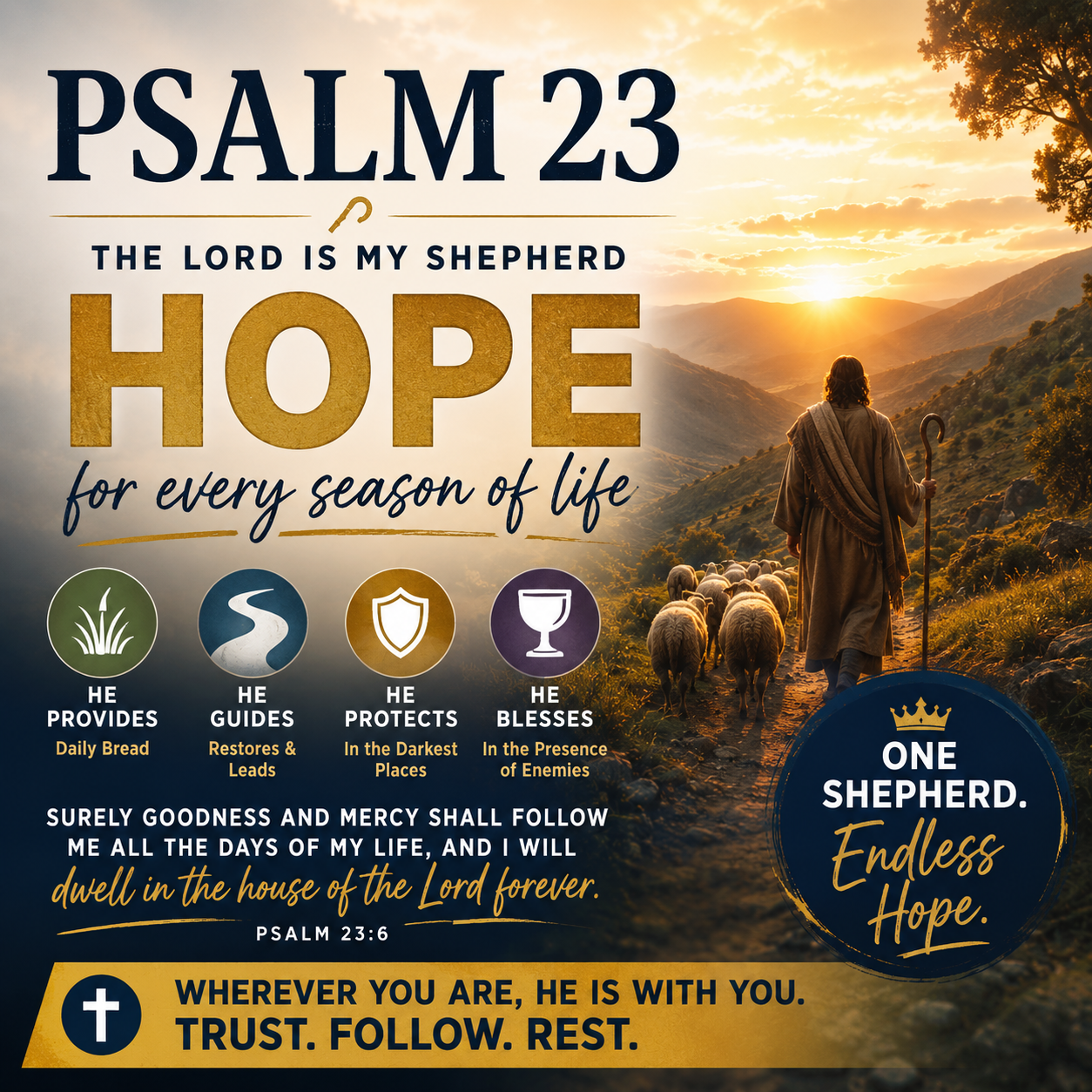
Psalm 23 – Part 2 – June 28, 2026 – The LORD is My Shepherd
Psalm 23 – Part 2 – 6.28.26
Click the blue heading to download notes:
PSALM 23
The Lord Is My Shepherd
Part 2 • Hope in Every Place
| Psalm 23 |
| Psalm 23:1 The LORD is my shepherd; I shall not want. |
| Psalm 23:2 He maketh me to lie down in green pastures: he leadeth me beside the still waters. |
| Psalm 23:3 He restoreth my soul: he leadeth me in the paths of righteousness for his name’s sake. |
| Psalm 23:4 Yea, though I walk through the valley of the shadow of death, I will fear no evil: for thou art with me; thy rod and thy staff they comfort me. |
| Psalm 23:5 Thou preparest a table before me in the presence of mine enemies: thou anointest my head with oil; my cup runneth over. |
| Psalm 23:6 Surely goodness and mercy shall follow me all the days of my life: and I will dwell in the house of the LORD for ever. |
Review |
The previous sermon explored why Psalm 23 has become one of the most recognized and widely used passages in all of Scripture. We compared it to a Swiss Army Knife because it is compact, versatile, and practical. In only six verses, David provides hope for a wide variety of life’s situations. HOPE is the key ingredient in the psalm. David expresses hope in every situation life has taken him.
| Verse 1 | The LORD is my shepherd; I shall not want. David declared that because God is his shepherd, he will never come up lacking or be deprived of the needs in his life. |
| Verse 2 | Hope for daily bread. David was confident God would provide his daily provisions, just as the shepherd leads the flock to green pastures and still waters. |
| Verse 3 | Hope through personal care. Just as a shepherd turns over a cast sheep and restores it, David was confident God would personally care for him in times of weakness and distress. |
Defining HOPE |
|
Our Modern Use of Hope A desire for something to happen. Expresses uncertainty. “I hope to attend that event” — I want to, but I am not sure I will. |
The Jewish Concept of Hope A confident expectation. Expresses certainty, not uncertainty. It is the assurance of what God will do. |
When we talk about Psalm 23 providing HOPE, we are talking about it inspiring in us a confident expectation of what God will do in our life — how He will provide for and protect us in all of life’s situations.
In verse 1, David expressed his hope — his confidence in God — by saying: because I have God as my shepherd, I will never come up lacking in life. The following verses explain that hope.
Verse 4 — Hope in the Darkest Places of Life |
| Psalm 23:4 Yea, though I walk through the valley of the shadow of death, I will fear no evil: for thou art with me; thy rod and thy staff they comfort me. |
This verse is most likely why Psalm 23 is used at funerals to comfort grieving families. But David is not expressing grief from losing a loved one. He is expressing hope in God for life — confident expectation in God for the darkest times in life.
Background: The Valley
Shepherds in the region around Bethlehem moved their flocks according to the seasons. As snow melted on the higher elevations, fresh grass grew on the mountain pastures. Shepherds would lead their sheep from the lower, drier grazing areas up to these greener pastures. When colder weather returned, they guided the flocks back down through the valleys to the warmer lowlands for winter.
Why the valleys were dark and dangerous:
|
The Change in Tone
Notice the places David described the shepherd taking him through in verses 1–3:
| • The shepherd led him to green pastures
• The shepherd led him to still waters • The shepherd was restoring his soul • The shepherd led him in the paths of righteousness |
All of these are positive and pleasant. It is easy to follow the shepherd to these places. It is easy to appreciate the shepherd when these are the places being led to.
Verse 4 changes from pleasant places to dark places. The term “valley of the shadow of death” does not describe the experience of dying. David was not talking about a shepherd leading his sheep to slaughter, but leading them through the darkest and most dangerous times in life — they are in the shadow of death.
Throughout the Old Testament the phrase is associated with darkness, gloom, danger, affliction, and death.
David Knew These Dark Places Personally
| As a shepherd — David literally walked through the dark valleys.
As a young man — David literally stood in the shadow of Goliath and fought to the death. As a servant of God — David lived on the run from Saul. As a king — David fought battles, faced uprisings from his own son, and defended the nation of Israel. |
But David is not expressing uncertainty or fear, and he is not complaining about the shepherd leading him through the valley. David is expressing HOPE. Confident expectation in God.
| His hope is declared: “I WILL FEAR NO EVIL”
His hope is rooted in: God is with him in the darkest places. |
| Have you ever noticed that David switches from talking about the shepherd in verses 1–3 to talking to the shepherd in verses 4–6? |
David says “I will fear no evil, for thou art with me, thy rod and thy staff they comfort me.” David has just as much hope and confidence in God regardless of where God is leading him. At times God leads him through the darkest places where death is close. But David knows God is leading him to a better place where once again he will lie down in green pastures beside still waters.
| Is that your experience? Do you have as much confidence and appreciation for God in the darkest places of life as you do in the green pastures? |
What Gave David His Confidence?
The presence of the shepherd — “For thou art with me.”
The sheep are confident in the shepherd. They know he will get them through the dark places, and that is the only reason they go into the dark valley. They would not go if the shepherd did not lead them.
|
Consider this: The green pasture on the mountain top looks good to the sheep. They wonder: why not just stay here? But the shepherd knows the mountain top is going to freeze. The green grass will fade and the sheep will die if they stay. So he leads them back through the valley of the shadow of death — because he knows on the other side is where the sheep will have food and water for the winter. |
The sheep’s life is a constant cycle of feeding in green pastures for a season, then moving through the valley of the shadow of death for a season, only to arrive at green pastures and still waters again. The hope David is expressing is that even though he is being led through a dark, painful, and scary time, God is with him and leading him to green pastures on the other side.
David was also mature enough to realize that no green pasture lasts forever — but neither does any dark valley.
The Rod and the Staff
| The Rod – A short club used as a weapon to defend the sheep from predators.
The Staff – The shepherd’s crook, used to direct the sheep, retrieve them when they fell out of reach, and keep them together. |
The sheep eventually learned that when the shepherd’s rod made contact with them, it was a good thing — it was leading them or retrieving them from danger and into safety.
ApplicationGod guides us with His Word. It convicts us of sin, leading us away from it, and retrieves us from sin when we wander from God. |
Verse 5 — Hope for Acceptance |
| Psalm 23:5 Thou preparest a table before me in the presence of mine enemies: thou anointest my head with oil; my cup runneth over. |
In verse 4 David switched from talking about God to talking to God as his personal shepherd. Now in verse 5 David shifts the imagery from God as shepherd to God as host of a banquet.
David has full assurance that when he comes through the valley of the shadow of death, he will feast at God’s table as an honored guest.
Ancient Near Eastern Hospitality
The imagery David uses — a table being prepared, anointing the guest’s head with oil, and providing wine in abundance — was all part of Ancient Near Eastern customs for welcoming, accepting, and honoring a guest.
| Luke 7:44–46 Jesus was a guest in the home of a Pharisee when a woman came in and began kissing the feet of Jesus, washing them with her tears, and anointing them with oil. Jesus called out the host because he had neglected to provide the basic hospitality — water for His feet or oil for His head. Jesus showed that this woman was more honorable than the host.
Luke 7:44–46 “Thou gavest me no water for my feet: but she hath washed my feet with tears, and wiped them with the hairs of her head. Thou gavest me no kiss: but this woman since the time I came in hath not ceased to kiss my feet. My head with oil thou didst not anoint: but this woman hath anointed my feet with ointment.” |
David is expressing confidence that God will accept him into His home — not merely as a tolerated guest, but as a person of honor and privilege. He is seated at the table with the host. The host anoints his head with oil that refreshes him. And David said “my cup runneth over” as a symbol of generosity with the wine. In the Bible, wine is associated with joy and celebration
David is confident that God will accept him, and that David will enjoy God’s blessings for eternity.
Verse 6 — Hope of Eternal Blessing |
| Psalm 23:6 Surely goodness and mercy shall follow me all the days of my life: and I will dwell in the house of the LORD for ever. |
David is confident that God’s favor is eternal. The joy and provision of living in God’s home is endless.
David’s Journey Through the Psalm
| Verses 1–2 God leads David into green pastures and beside still waters. Life is as good as it gets.
Verse 3 God restores his soul and leads him in righteousness. Life is good, but it takes detours through dark, sad, and dangerous valleys. Verse 4 David continues to follow and trust God through the dark places. Verses 5–6 David arrives on the other side of the darkness, accepted into God’s home as an honored guest. He is rewarded for following God in good times and bad with endless joy and provision. |
Conclusion |
When we started talking about Psalm 23, we compared it to a Swiss Army Knife because it is compact — just six verses — but it has something for everyone, regardless of age, health, or circumstance.
What is the one thing Psalm 23 has for everyone?It offers HOPE — confident expectation in God for every situation and every need in life. |
Challenge
| • Read Psalm 23 every day until you memorize it.
• Quote Psalm 23 when you celebrate an answered prayer or victory. • Quote Psalm 23 when you face the dark, scary, or sad moments in life. • Share Psalm 23 with someone when they are celebrating joy or facing dark times. |
Send and save your notes
Download a PDF version
Email notes to yourself
Copy to your clipboard