
Establishing A Prayer Legacy – Lesson 4 – July 5, 2026 – Legacy
Establishing A Prayer Legacy – Lesson 4 – July 5, 2026
Click the Heading Above To Download Notes
Establishing A Prayer Legacy
Lesson 4 — Legacy
Review
In Lesson 1, we learned that Jesus established a prayer legacy by exposing His disciples to His prayer life. The disciples observed His prayer rhythm. They saw Him pray before important events, decisions, and needs. They saw that prayer was part of His relationship with the Father. Through that exposure, they became aware that prayer was central to His life. We learned that the first step of establishing a prayer legacy is Initiation.
In Lesson 2, we learned that Jesus moved from Initiation to Influence. He did more than expose the disciples to His prayer life; He invited them into it. He prayed with them, asked them to pray with Him, and shared burdens with them. We learned that influence is created when people experience our prayer life touching their life through participation.
In Lesson 3, we learned that prayer eventually becomes part of our reputation. Prayer becomes part of how people know us. Jesus became identified with prayer. Samuel became identified with intercession. Epaphras became identified as a man who labored fervently in prayer for others. We learned that Identity is reached when prayer becomes part of how people know us.
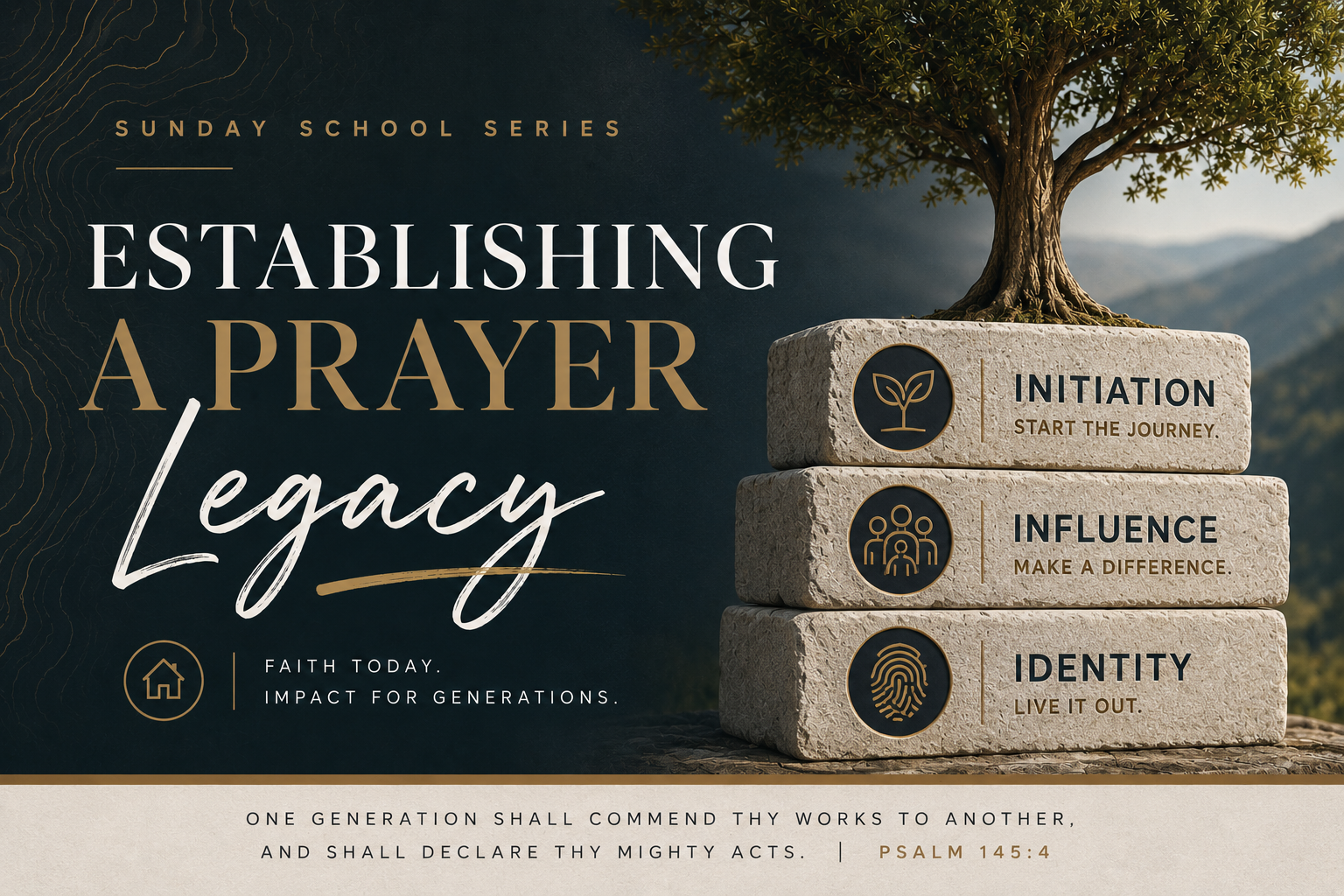
Today we arrive at the fourth stage of a prayer legacy: Legacy. A legacy develops when the people we have exposed to prayer, invited into prayer, and influenced through prayer continue living out those same prayer principles in their own lives. They continue praying. They continue carrying burdens before God. They continue influencing others through prayer. Today we will define a legacy and learn what it means for a prayer life to continue long after we are gone.
What Is A Legacy?
Most people have heard the word legacy, but we do not always stop to think about what it means. When someone dies, people often talk about the legacy they left behind. They speak about the impact that person had on others and the things that continue because of their life. Parents leave a legacy when their children continue practicing the values they were taught. Teachers leave a legacy when students continue applying what they learned. Pastors leave a legacy when the people they disciple continue living out biblical truth. At its simplest level, a legacy is something that continues after we are gone. It is the influence of our life continuing through the lives of others.
The same principle applies to prayer. A prayer legacy is established when the prayer principles we faithfully practice continue in the lives of other people. Through Initiation, people are exposed to our prayer life. Through Influence, they participate in our prayer life. Through Identity, they associate us with prayer. Over time, those experiences shape them. They learn to expose others to prayer, pray with people, carry burdens before God, and develop a reputation as people of prayer themselves. A prayer legacy exists when the people we leave behind continue living out the prayer life we modeled before them.
Jesus Is Our Model
Jesus is our model for what it looks like to leave a prayer legacy.
In Lesson 1, we learned that Jesus initiated His disciples into a life of prayer by exposing them to His prayer life. They observed His prayer rhythm and saw prayer woven into everyday life. In Lesson 2, we learned that Jesus influenced His disciples through prayer. He prayed with them, taught them to pray, and asked them to pray with Him. In Lesson 3, we learned that prayer became part of His identity. His disciples associated Him with prayer and came to Him saying, “Lord, teach us to pray.”
The book of Acts shows those same prayer principles continuing after Jesus returned to Heaven.
Acts 1 records the days immediately following the ascension. The disciples gathered together with the other believers and “continued with one accord in prayer and supplication” (Acts 1:14). The prayer life Jesus had exposed them to now continued in their own lives. The apostles had become the initiators. The believers gathered around them were now being exposed to a life of prayer just as the apostles had been exposed to prayer through Jesus. Before selecting a replacement for Judas, they prayed together and sought God’s direction. The prayer life Jesus modeled was continuing in His disciples.
Acts 4 shows those same prayer principles spreading throughout the church. Peter and John returned after being threatened by the religious leaders and shared what had happened. The church gathered together in prayer. The burden was no longer carried by Peter and John alone. The believers joined together and brought the situation before God. The apostles were now doing for the church what Jesus had done for them. They were inviting others into the ministry of prayer. The influence Jesus established through prayer was now being passed to others.
Acts 12 reveals that prayer had become part of the church’s identity. Peter was arrested and placed in prison. The church responded by gathering together and praying without ceasing for him. Acts 12:5 says, “Peter therefore was kept in prison: but prayer was made without ceasing of the church unto God for him.” When Peter was delivered from prison, he went to the house of Mary where many believers were still gathered together praying. By this point, prayer had become part of the culture of the church. The people knew what to do when a burden arose. They prayed. The people knew where to go when a crisis came. They gathered together in prayer. The prayer life that once identified Jesus was now identifying His followers.
The progression through Acts shows a prayer legacy in action.
- Jesus initiated His disciples into a life of prayer.
- The disciples influenced others through prayer.
- The church became identified with prayer.
- As new believers joined the church, they were exposed to those same prayer principles and experienced them firsthand.
What began in the life of Jesus continued in the lives of His disciples, and what continued in the lives of His disciples continued in the life of the church. That is a prayer legacy.
Building A Prayer Legacy
A prayer legacy is built through people. Jesus invested in His disciples. The disciples invested in the church. The church invested in the next generation of believers. In every case, the prayer life of one generation continued in the lives of the next generation.
The same opportunity exists for us today. Every one of us has people within our circle of influence. Family members, church members, friends, co-workers, classmates, teammates, neighbors, and others are being exposed to our prayer life. They observe whether prayer is part of our daily life. They know whether we ask others to pray, whether we pray for others, whether we follow up on prayer requests, and whether we speak about God’s answers to prayer. They learn what place prayer holds in our life by observing the way we live.
The examples we have studied throughout this series remind us that a prayer legacy does not begin after we are gone. A prayer legacy is established while we are still present in the lives of others. As people are exposed to our prayer life, included in our prayer life, and influenced by our prayer life, they begin developing a prayer life of their own.
The question is not whether we will leave a legacy. The question is what kind of legacy we will leave. Who is being exposed to prayer through our life? Who are we praying with? Who are we teaching to carry needs before God? Who may continue a life of prayer because of the influence we have today?
A prayer legacy continues when the prayer life we live today becomes part of the life of someone else tomorrow.
What Must Continue?
A prayer legacy involves more than people remembering that we prayed. A prayer legacy exists when the prayer life we modeled continues in the lives of others.
As disciples, our goal is to imitate Jesus. We follow His example and seek to live as He lived. Throughout this series, we have studied the prayer life of Jesus. We observed His prayer rhythm. We watched Him include others in prayer. We saw prayer become such a defining characteristic of His life that His disciples associated Him with prayer. As disciples, we are learning to live out that same kind of prayer life.
This helps us understand what must continue. We are not simply trying to pass along the habit of praying. We are seeking to pass along the prayer life Jesus modeled. We want others to see prayer woven into everyday life. We want others to experience praying with and for one another. We want others to become people who are identified with prayer. In doing so, they are continuing the example Jesus established for His disciples.
This is exactly what we saw in the book of Acts. The disciples continued living out the prayer life Jesus modeled before them. As the church grew, new believers learned that same prayer life from the apostles and from one another. What began in the life and ministry of Jesus continued through His followers.
A prayer legacy continues whenever disciples help others live out the prayer life of Jesus. The life we received from others is passed to the next generation through our example, our influence, and our investment in their lives.
Coming Up
In our next lesson, we will move from teaching to demonstration. Together, we will walk through everyday situations and see what a prayer legacy looks like in action. We will observe how Initiation, Influence, Identity, and Legacy can be lived out through the relationships and opportunities God places in our lives.
Send and save your notes
Download a PDF version
Email notes to yourself
Copy to your clipboard