Understanding Easter – Day of Atonement – March 15, 2026
Understanding Easter – Lesson 3 – Day of Atonement – March 15, 2026
Introduction
This is the third of five sermons in a mini-series called: Understanding Easter.
Our Goal is to prepare for Easter Celebration by understanding what Jesus accomplished and experienced through the Crucifixion, Death, Burial, & Resurrection.
Review: The main takeaway from the first two sermons, is that God literally took control of Israels Calendar. God determined when they would: Work, Rest, Worship
God placed 7 annual Holy Days on Israel’s calendar. In addition, He scheduled monthly and weekly Sabbaths (times of rest)
The way God scheduled their life for them meant that Israel’s entire year was designed to have a consistent rhythm that looked like this: All Israel Stopped Their Work; All Israel Assembled Before God; And all of Israel was being taught about — sin, judgment, and salvation through the blood of a sacrifice.
The way God structured Israel’s calendar means they could not go more than a few weeks without stopping everything and standing before God.
Why did God do this? Because He was preparing the world to understand what the Messiah (Jesus) would accomplish at Calvary. Through these ceremonies and rituals, God taught us what Jesus did with our sin through His death, burial, and resurrection.
Paul explains this in Galatians 3:24 when he says: “24 Wherefore the law was our schoolmaster to bring us unto Christ, that we might be justified by faith.”
________________________________________________________________________________________________________________________________________________________________________________________________________________________
What Was the Day of Atonement?
The Day of Atonement was the ONE day each year where God allowed a goat, to die as a substitute for Israel, as payment for their sin. And we may ask Why Was It Necessary?
Humans Are Created in God’s Image:
Human beings are created in the image of God. Genesis 1:27 says, “So God created man in his own image, in the image of God created he him.” From the beginning, people were made to reflect God’s character and live in fellowship with Him.
We Have Failed: (SIN)
Sin is anything in us that falls short of God’s character and holiness. God is perfectly righteous and holy in everything He does, and anything in our thoughts, words, or actions that does not match His character is sin. For all have sinned: Romans 3:23 says “For all have sinned, and come short of the glory of God.” Every person has fallen short of the holiness that reflects God’s image.
The Penalty of Sin:
The Bible teaches that sin carries a penalty. Romans 6:23 says, “For the wages of sin is death.” This means that sin brings separation from God.
Because of our sin, we cannot be in God’s presence:
Because God is holy, sin cannot remain in His presence. Isaiah 59:2 says, “But your iniquities have separated between you and your God.” Before anyone can approach God, their sin must be paid for and removed. This is why God gave Israel the Day of Atonement, a day when the nation’s sin was brought before Him so that payment could be made.
Where to find the Day of Atonement in the Bible: Leviticus 16, 23, 25; Numbers 29:7-11; Exodus 30:10.
This was the most important day of the year for the Jewish people.
Leviticus 16:29–30 – 29 And this shall be a statute for ever unto you: that in the seventh month, on the tenth day of the month, ye shall afflict your souls, and do no work at all, whether it be one of your own country, or a stranger that sojourneth among you: 30 For on that day shall the priest make an atonement for you, to cleanse you, that ye may be clean from all your sins before the LORD.
The word “atonement” means to make payment or satisfaction for sin. ________________________________________________________________________________________________________________________________________________________________________________________________________________________
Sin Debt Is Growing:
Each day they lived, Israelites were adding new debts to their sin account. And God was keeping a record of their sins. Just as He is doing with people today.
Revelation 20:12 – 12 And I saw the dead, small and great, stand before God; and the books were opened: and another book was opened, which is the book of life: and the dead were judged out of those things which were written in the books, according to their works.
Daniel 7:10 – 10 A fiery stream issued and came forth from before him: thousand thousands ministered unto him, and ten thousand times ten thousand stood before him: the judgment was set, and the books were opened.
Ecclesiastes 12:14 – 14 For God shall bring every work into judgment, with every secret thing, whether it be good, or whether it be evil.
Matthew 12:36 – 36 But I say unto you, That every idle word that men shall speak, they shall give account thereof in the day of judgment.
Jeremiah 17:1- 1 The sin of Judah is written with a pen of iron, and with the point of a diamond: it is graven upon the table of their heart, and upon the horns of your altars;
Romans 14:10–12 – 10 But why dost thou judge thy brother? or why dost thou set at nought thy brother? for we shall all stand before the judgment seat of Christ. 11 For it is written, As I live, saith the Lord, every knee shall bow to me, and every tongue shall confess to God. 12 So then every one of us shall give account of himself to God.
Every day, the people committed sin in some way and God is keeping a record. Their debt is growing larger and larger. ________________________________________________________________________________________________________________________________________________________________________________________________________________________
The BIG QUESTION: What happens if their sin debt is not paid? They would be cut off from God and they would have to pay for their sin with their own life, and cast into the lake of fire.
Isaiah 59:2 –2 But your iniquities have separated between you and your God, and your sins have hid his face from you, that he will not hear.
Romans 6:23 –23 For the wages of sin is death; but the gift of God is eternal life through Jesus Christ our Lord.
Hebrews 9:27 – And as it is appointed unto men once to die, but after this the judgment:
Revelation 20:15 – 15 And whosoever was not found written in the book of life was cast into the lake of fire.
The Good News
God provided a way for their sin to be atoned, paid for each year. They had a chance at a clean slate every year. Day of Atonement
The Setting: The Tabernacle
To understand what happened on the Day of Atonement, we need to understand where it took place. Israel was living in the wilderness, and God had given them detailed instructions to build a portable sanctuary called the tabernacle. Exodus 25:8 records God’s purpose: “And let them make me a sanctuary; that I may dwell among them.”
The tabernacle was God’s dwelling place on earth – the place where the holy God of heaven came down to live among His sinful people.
The Tabernacle
The tabernacle had three sections, each with different levels of access. The outer court was where the people could come to bring their sacrifices. Here stood the altar where animals were killed and burned, and the laver where priests washed before serving God.
The second section was called the holy place. Only the priests could enter here to perform their daily duties. This room contained the table of showbread, the golden candlestick, and the altar of incense.
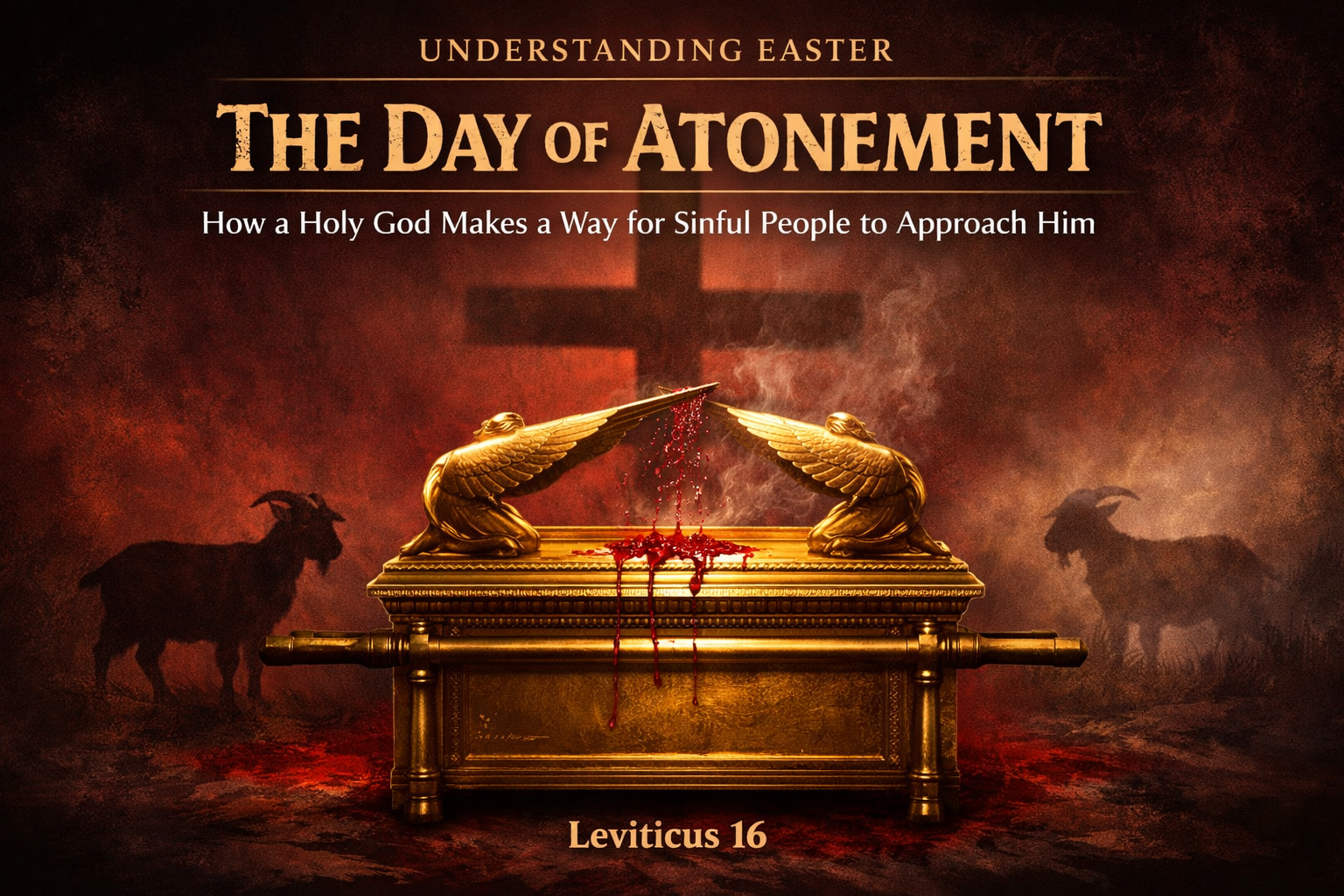
The third section was the Holy of Holies – the most sacred place on earth. This was where God’s presence dwelled above the ark of the covenant. Inside the ark were the stone tablets of the Ten Commandments, and the lid of the ark was called the mercy seat, made of pure gold with two cherubim looking down upon it.
A thick veil separated the Holy of Holies from the holy place. Exodus 26:33 says this veil would “divide unto you between the holy place and the most holy.” No one could enter this room except the high priest, and he could only enter once each year on the Day of Atonement. To enter any other time meant death. ________________________________________________________________________________________________________________________________________________________________________________________________________________________
The Ceremony Itself
Now that we understand the setting, let’s walk through what actually happened on the Day of Atonement.
The High Priest Prepared Himself
Leviticus 16:4 – 4 He shall put on the holy linen coat, and he shall have the linen breeches upon his flesh, and shall be girded with a linen girdle, and with the linen mitre shall he be attired: these are holy garments; therefore shall he wash his flesh in water, and so put them on.
Next, he had to deal with his own sin first. Verse 6 explains: “And Aaron shall offer his bullock of the sin offering, which is for himself, and make an atonement for himself, and for his house.”
The high priest was a sinner just like everyone else. Before he could represent the people before God, he had to have his own sin paid for through the blood of a bull. Only after his own sin was covered could he begin the ceremony for the people’s sin. And this is where the two goats come in. ________________________________________________________________________________________________________________________________________________________________________________________________________________________
The Two Goats
Leviticus 16:7–8 – 7 And he shall take the two goats, and present them before the LORD at the door of the tabernacle of the congregation. 8 And Aaron shall cast lots upon the two goats; one lot for the LORD, and the other lot for the scapegoat.
Two goats were brought before God, and lots were cast to determine which goat would be sacrificed and which goat would serve as the scapegoat and carry away the sin of the people
________________________________________________________________________________________________________________________________________________________________________________________________________________________
The first goat was killed as a sin offering.
Leviticus 16:15 – 15 Then shall he kill the goat of the sin offering, that is for the people, and bring his blood within the vail, and do with that blood as he did with the blood of the bullock, and sprinkle it upon the mercy seat, and before the mercy seat. This goat died to pay for the people’s sin. Its blood was carried into the Holy of Holies and sprinkled on the mercy seat – the very place where God’s presence dwelled. When God saw this blood, He accepted it as payment for Israel’s sin. The innocent goat died so the guilty people could live. ________________________________________________________________________________________________________________________________________________________________________________________________________________________
The second goat– the scapegoat – was not killed.
Leviticus 16:21 – 21 And Aaron shall lay both his hands upon the head of the live goat, and confess over him all the iniquities of the children of Israel, and all their transgressions in all their sins, putting them upon the head of the goat, and shall send him away by the hand of a fit man into the wilderness:
The high priest placed his hands on this goat’s head and confessed every sin that Israel had committed throughout the year. In a symbolic way, all their guilt was transferred to this goat. The goat was led away into the wilderness, carrying their sins far from the camp where they could never return.
What This Teaches Us About Sin
Why was such an elaborate ceremony necessary? What does this teach us about our sin problem?
First, sin separates us from God: Isaiah 59:2 – 2 But your iniquities have separated between you and your God, and your sins have hid his face from you, that he will not hear.
Second, Sin requires death as payment. Romans 6:23 – 23 For the wages of sin is death; but the gift of God is eternal life through Jesus Christ our Lord.
The first goat had to die – there was no other way to deal with sin. The innocent goat died so the guilty people could live. Sin cannot be overlooked, ignored, or worked off. And it demands the life of the sinner or the life of a substitute.
Third, Sin brings guilt that must be completely removed. It wasn’t enough for the first goat to die – the second goat had to carry their guilt away into the wilderness. Sin leaves us defiled and guilty before God. Both problems had to be addressed. ________________________________________________________________________________________________________________________________________________________________________________________________________________________
Jesus Is Both
The Day of Atonement was a shadow pointing forward to what Jesus Christ would accomplish. Hebrews 10:1- 1 For the law having a shadow of good things to come, and not the very image of the things, can never with those sacrifices which they offered year by year continually make the comers thereunto perfect.
What the earthly high priest could only do temporarily with animal blood, Jesus did permanently with His own blood. ________________________________________________________________________________________________________________________________________________________________________________________________________________________
Jesus as Our High Priest
First, Jesus became our High Priest. Hebrews 7:26–27 – 26 For such an high priest became us, who is holy, harmless, undefiled, separate from sinners, and made higher than the heavens; 27 Who needeth not daily, as those high priests, to offer up sacrifice, first for his own sins, and then for the people’s: for this he did once, when he offered up himself. ________________________________________________________________________________________________________________________________________________________________________________________________________________________
Jesus as Our Sacrifice
Second, Jesus became the sacrifice itself. John the Baptist pointed to this when he said in John 1:29 – 29 The next day John seeth Jesus coming unto him, and saith, Behold the Lamb of God, which taketh away the sin of the world.
When Jesus hung on the cross, He was paying the penalty that our sin deserved. Isaiah 53:5–6 – 5 But he was wounded for our transgressions, he was bruised for our iniquities: the chastisement of our peace was upon him; and with his stripes we are healed. 6 All we like sheep have gone astray; we have turned every one to his own way; and the LORD hath laid on him the iniquity of us all.
Just as the goat’s blood was sprinkled on the mercy seat in the earthly Holy of Holies, Jesus took His own blood into the heavenly Holy of Holies. Hebrews 9:12 – 12 Neither by the blood of goats and calves, but by his own blood he entered in once into the holy place, having obtained eternal redemption for us. ________________________________________________________________________________________________________________________________________________________________________________________________________________________
Jesus as Our Scapegoat
Third, Jesus also became our scapegoat. He didn’t just pay for our sin, He carried it completely away from us. This happened when He suffered outside the city of Jerusalem, just like the scapegoat was sent outside the camp. Hebrews 13:11–12 – 11 For the bodies of those beasts, whose blood is brought into the sanctuary by the high priest for sin, are burned without the camp. 12 Wherefore Jesus also, that he might sanctify the people with his own blood, suffered without the gate. ________________________________________________________________________________________________________________________________________________________________________________________________________________________
The Proof: Coming Back Alive
On the Day of Atonement, the people waited anxiously outside while the high priest was behind the veil in God’s presence. They knew that if God rejected the sacrifice, the high priest would die in the Holy of Holies. But when he came back out alive, they knew God had accepted the atonement and their sins were forgiven for another year.
Jesus’ resurrection serves the same purpose.
When He died on the cross, He went behind the veil into the presence of God with His own blood. When He rose from the dead three days later, it proved that God had accepted His sacrifice. His resurrection is our proof that perfect atonement has been made for our sins. ________________________________________________________________________________________________________________________________________________________________________________________________________________________
Jesus: A Better Sacrifice:
Here’s the crucial difference between the Day of Atonement and what Jesus accomplished. The earthly ceremony had to be repeated every single year. Hebrews 10:3 3 But in those sacrifices there is a remembrance again made of sins every year. But Jesus’ sacrifice was far better. Hebrews 10:10 – 10 By the which will we are sanctified through the offering of the body of Jesus Christ once for all. Jesus doesn’t have to die again every year. His resurrection proves His work is finished and accepted by God forever. ________________________________________________________________________________________________________________________________________________________________________________________________________________________
ONE MORE DETAIL
Leviticus 16:29 – 29 And this shall be a statute for ever unto you: that in the seventh month, on the tenth day of the month, ye shall afflict your souls, and do no work at all, whether it be one of your own country, or a stranger that sojourneth among you:
Leviticus 16:31 31 It shall be a sabbath of rest unto you, and ye shall afflict your souls, by a statute for ever.
Leviticus 23:27 27 Also on the tenth day of this seventh month there shall be a day of atonement: it shall be an holy convocation unto you; and ye shall afflict your souls, and offer an offering made by fire unto the LORD.
Leviticus 23:29 29 For whatsoever soul it be that shall not be afflicted in that same day, he shall be cut off from among his people.
The people were not passive observers; They were not casual participants; They were required to afflict their soul, which means to humble themselves before God.
Psalm 35:13 13 But as for me, when they were sick, my clothing was sackcloth: I humbled my soul with fasting; and my prayer returned into mine own bosom.
Psalm 69:10 When I wept, and chastened my soul with fasting, that was to my reproach.
Ezra 8:21 21 Then I proclaimed a fast there, at the river of Ahava, that we might afflict ourselves before our God, to seek of him a right way for us, and for our little ones, and for all our substance.
While the High Priest played a crucial role in this Day of Atonement. And the two goats were necessary for sin to be forgiven. God also required the people, whose sin was being atoned that day, to humble themselves and take this day seriously. They were required to cease from work, Assemble together before God, and Humble themselves to acknowledge shame and guilt over sin. This was demonstrated by fasting and eventually, they wore sackcloth and sat in ashes.
Isaiah 58:3–5 3 Wherefore have we fasted, say they, and thou seest not? wherefore have we afflicted our soul, and thou takest no knowledge? Behold, in the day of your fast ye find pleasure, and exact all your labours. 4 Behold, ye fast for strife and debate, and to smite with the fist of wickedness: ye shall not fast as ye do this day, to make your voice to be heard on high. 5 Is it such a fast that I have chosen? a day for a man to afflict his soul? is it to bow down his head as a bulrush, and to spread sackcloth and ashes under him? wilt thou call this a fast, and an acceptable day to the LORD?
In this last verse God taught them that fasting out of routine did not merit God’s favor. He required them to be sincere, humble, and broken over their sin. The outward actions must reveal what was genuinely in their heart toward God and sin. ________________________________________________________________________________________________________________________________________________________________________________________________________________________
Conclusion:
This Easter, you will have a better understanding and appreciation of what Jesus accomplished through the cross and the death, burial, and resurrection.
You are better equipped to celebrate Easter than you were before this series began.
The Big Question is: Will you humble yourself? It is impossible to properly celebrate Jesus erasing our sin debt unless we first realize how great our sin debt was/is. ________________________________________________________________________________________________________________________________________________________________________________________________________________________
Did You Know:
Christians meet on Sunday because it is the day of the week that Jesus rose from the grave? Based on what you learned in this sermon, how serious do you take Sunday worship?
- Do you prioritize Sunday?
- Are you a casual observer of church service?
- Do you take steps to humble yourself before you engage in worship?
- What changes will you make regarding Sunday based on what you now know?
________________________________________________________________________________________________________________________________________________________________________________________________________________________________________________________________________________________________