
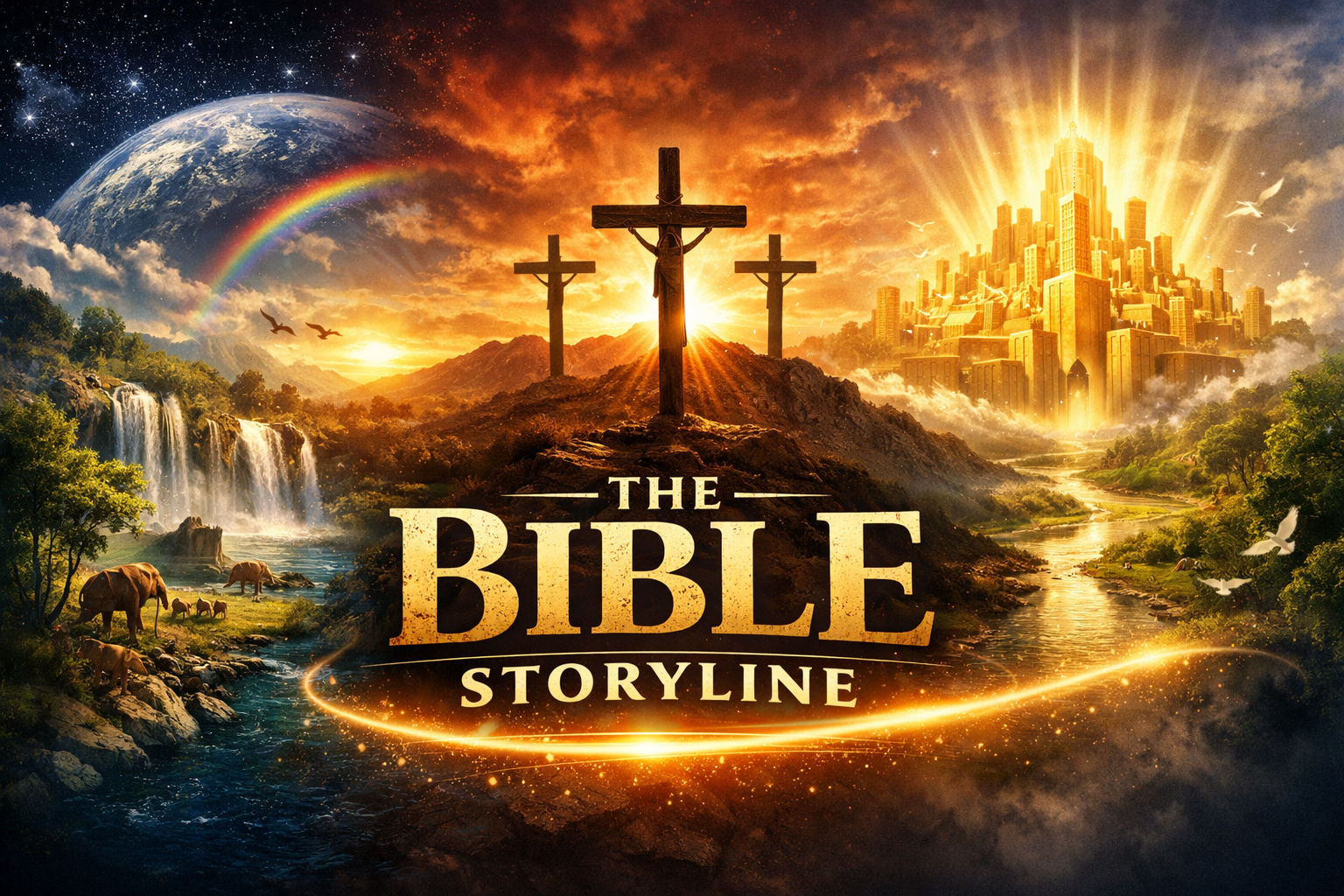
The Bible’s Storyline – Introduction Lesson
Click to Download: The Bible Storyline – Introduction Lesson
The Bible’s Storyline – Introduction Lesson
Why This Bible Study?
Before answering that question let’s see how well you know the main Bible Storyline? We will start with a few popular Bible stories:
What did God originally want us to learn from the story of Noah?
A. Obey God even when it seems impossibleB. Stay faithful when nobody around you believesC. God will protect you through life’s stormsD. God can use ordinary people to do extraordinary thingsE. God judged sin and kept His promise to send a Redeemer
What did God originally want us to learn from the story of David and Goliath?
A. God helps you overcome the giants in your lifeB. Faith and courage can defeat any obstacleC. God uses ordinary people to do extraordinary thingsD. God rewards those who are brave enough to stand up for what is rightE. God defended His name and protected His people so His promise to send a Redeemer would not fail
What did God originally want us to learn from the story of Esther?
A. Speak up for others even when you are afraidB. You have a purpose for being where you areC. One brave person can change everythingD. God protects those who are willing to risk everything for HimE. God prevented Haman from destroying the Jews so His promise to send a Redeemer through the bloodline of Abraham would not fail
The first thing you will notice is that all the answers seem correct. But when we read the question carefully, we understand that only one answer is correct and it is E. Here is why.
Look carefully at the question. It asks what did God originally want us to learn. God had one overarching purpose running through every story in the Bible — to send a Redeemer, redeem mankind and restore creation. Every story He recorded is connected to that purpose. When we read Noah, David and Esther through that lens everything changes.
God is not dropping into each story to teach us a personal life lesson. He is actively fulfilling His promise and purpose for creation.
That is why E is the correct answer in all three. Each one shows us God protecting and advancing His promise — and that is the storyline of the Bible.
Noah’s Ark
Perhaps the very way we refer to this story reveals that we are not reading it the way God intended. Today we pull out the story of “Noah’s Ark” or “Noah and the Flood” and we read it as if it were a single story contained within the Bible. When it actually is part of the bigger storyline of the Bible that started in Genesis 1.
So, let me ask: When you think of the story of Noah’s Ark does your mind go back to creation week?…. Probably not, but it should. Do you know why?
What do you need to know about creation week that unlocks the meaning of this story?
|
|
|
|
Now, as we come to Genesis 6 we learn that mankind has done the opposite of what God commanded. Instead of filling the earth with God’s image they have filled it with sin, violence and corruption.
|
Genesis 6:5 says “every intention of the thoughts of man’s heart was only evil continually.” |
|
Genesis 6:6 says “And it repented the LORD that he had made man on the earthand it grieved him at his heart.” |
God’s image bearers had become the opposite of everything He created them to be.
God had the power and the right to destroy every living person on the earth and start over. But He had already bound Himself to a promise in Genesis 3 to send a Redeemer who would be born into the world. That promise meant mankind had to survive. So, God judged sin through the flood and destroyed everyone on the earth except Noah and his family — preserving the one family through whom His promise would continue.
This is the story of God — judging sin, protecting His promise and refusing to abandon His original purpose for creation.
So, if we return to our multiple choice we will see that E is the correct answer — God judged sin and kept His promise to send a Redeemer.
Does that mean we cannot learn about faith and trusting God through this story? Of course we can. But those lessons come after we first understand what God is doing.
- We learn first about the seriousness of sin and God’s judgment of it.
- We learn about God’s original purpose for mankind as His image bearers and how completely sin had corrupted that purpose.
- We learn that God judged sin so severely He destroyed every living person on the earth except one family.
- We learn that God keeps His promises no matter what the cost. Out of all ofthat Noah’s faith and obedience emerge as a powerful example.
But they were never meant to be the main point. God’s judgment, God’s promise and God’s purpose are the main point.
Noah’s faith is part of the story not the center of it.
And we would never see any of that if we only read this as the story of Noah and the Ark. It is only when we read it through the lens of the Bible’s full storyline that God’s original purpose becomes clear. That is why the storyline matters.
David & Goliath
Just as we did in the story of Noah we need to ask — what do you need to know about Genesis 3 and the bigger storyline of the Bible to understand what God originally wanted you to see in this story?
You need to remember two things.
|
• In Genesis 3 God promised that a Redeemer would come through the seed of Eve to crush the serpent and reverse the curse of sin on mankind and creation.
|
|
• Then in Genesis 12 God narrowed that promise further by declaring that the Redeemer would come specifically through the bloodline of Abraham. This meant that Abraham’s descendants — the nation of Israel — had to survive. If Israel was wiped out the promise could not be kept and the Redeemer could never come.
|
Now keep that in mind as we come to this story.
When we arrive at the story of David and Goliath we find Goliath — a warrior from the Philistines who were mortal enemies of Israel — standing in the open and publicly defying the God of Israel. Not one person in Israel’s army including their king Saul was willing to do anything about it.
So, God did something about it. And He did it in a way that would make every nation take notice. He sent a shepherd boy who had never fought a battle or served in the army. David said it himself in 1 Samuel 17:45-46 — “I come to you in the name of the Lord of hosts…that all the earth may know that there is a God in Israel.”
David knew who the main character was. It was God.
Without knowing the bigger storyline of the Bible this looks like a story about a brave young man defeating a giant against all odds. And that is exactly how it gets preached. The giant becomes cancer, fear, financial problems or any struggle we face. And the lesson becomes — stand up to your giant like David did and God will take care of it.
But that is not what God originally intended us to learn. God was not helping David defeat a personal problem. God was defending His name and protecting the people through whom His promise to send a Redeemer would be kept. That is what E points to — God defended His name and protected His people so His promise to send a Redeemer would not fail.
Can we learn about courage and faith from this story? Absolutely. But only after we first see what God is doing. And we only see what God is doing when we read it through the lens of the bigger storyline of the Bible.
Esther
Just as we did in the stories of Noah and David we need to ask — what do you need to know about the bigger storyline of the Bible to understand what God originally wanted you to see in this story?
You need to remember the promise. God had committed Himself to sending a Redeemer through the bloodline of Abraham. That meant Abraham’s descendants — the nation of Israel — had to survive. In the book of Esther, a man named Haman had convinced the king of Persia to issue a decree to destroy every Jewish person in the entire empire. Every single one. If that happened the bloodline through whom the Redeemer would come would be cut off and God’s promise could not be kept.
God is never mentioned by name in the entire book of Esther. But His fingerprints are on every page. Every event that seems like a coincidence — Esther becoming queen, Mordecai uncovering the assassination plot, the king’s sleepless night — was God quietly working to protect His promise.
This is not a story about one brave woman. It is the story of God making sure that nothing and nobody could stop what He promised in Genesis 3. That is what E points to — God prevented Haman from destroying the Jews so His promise to send a Redeemer through the bloodline of Abraham would not fail.
The Bible Storyline Series
This is why The Bible Storyline Series is important. It will put God back at the center of the Bible and teach us to read it the way He originally intended.
As we work through the storyline from Genesis to Revelation
|
• you will see how every story connects to one unbreakable plan.
|
|
• You will see God’s character more clearly — not as a God who exists to fix your problems but as a God who has been actively working since creation to redeem mankind and restore the earth to its original purpose.
|
The principles and life lessons you have always loved in Scripture will make far more sense when you understand how they come out of the bigger storyline of the Bible. And knowing that storyline will protect you from drawing the wrong meaning from a story or claiming a promise that was never meant for you.
Bible Verses / Memory Verses
Just as we can misread a Bible story by pulling it out of the bigger storyline, we can do the same thing with individual Bible verses. Here are a few of the most popular examples:
Jeremiah 29:11 — “For I know the plans I have for you declares the Lord, plans to prosper you and not to harm you.”
What is Jeremiah 29:11 promising you?
|
A. God has a great plan for your life |
|
B. God will prosper you and protect you |
|
C. God will give you hope and a future |
|
D. All of the above |
|
E. None of the above |
By now you know the answer is “E” none of the above. Why not? Because this verse was not written about you or me, and God did not speak that promise to you or me.
This promise was made by God to the nation of Israel when they were captives in Babylon. And it is traced directly back to the God’s promise in the Garden to send a Savior. We have learned by now that God would send the Savior through the nation Israel and this is God’s way of keeping that promise. He was telling them you will not be annihilated in Babylon I will leave you here for 70years then bring you home. “I know the plans I have for you…” these are not words we can claim for ourselves it was God’s plans for Israel. This means we are not allowed to just claim this verse and expect God to fulfill BIG PLANS for our life.
But how do we know this if we only read or pull out one verse? We don’t! We must learn and follow the Bible Storyline from start to finish. That is the only way to apply scripture properly.
Philippians 4:13 — “I can do all things through Christ who strengthens me.”
The promise in Philippians 4:13 was written by Paul from prison. He was not talking about achieving goals or chasing dreams. Paul had been beaten, shipwrecked, starved and imprisoned for one reason — carrying the gospel of Jesus Christ to the Gentile world. That mission was the fulfillment of God’s promise to Abraham that his blessing would reach all nations. Paul was saying that Christ gave him the strength to endure anything — plenty or nothing — because God’s mission through him would not be stopped by his circumstances.
This verse is about God sustaining Paul through suffering to fulfill His covenant promise. It is not about you or me being able to do whatever we put our minds to.
Romans 8:28 — “All things work together for good.”
Romans 8:28 is not a promise that everything in your life will turn out fine. From the very beginning of the Bible’s storyline God created mankind to image Him on the earth. Genesis 1 tells us God made mankind in His image. Sin broke that. And from that moment forward everything God does in the Bible is aimed at restoring His image in mankind. That is the storyline. Romans 8:28 is connected directly to that story. When God says He works all things together for good He defines what that good is in the very next verse — being conformed to the image of Christ. In other words, imaging Jesus. God is using everything in your life including your suffering to restore what sin destroyed from the beginning — mankind imaging God. This verse is not a promise that your circumstances will improve. It is God declaring that His original purpose for mankind will not be defeated by sin, by suffering or by anything else.
Matthew 18:20 — “Where two or three are gathered in my name there I am.”
Matthew 18:20 is one of the most misquoted verses in the Bible. People use it to mean God shows up whenever a small group gathers to pray or worship. But Jesus said this in the middle of a passage about church discipline — what to do when a believer refuses to repent of sin. From the beginning of the Bible’s storyline God has been building a holy people who image Him on the earth. Sin inside that community threatens everything God is building. So Jesus gave the church authority to deal with unrepentant sin and promised to be present in that process. That is what this verse means.
In addition, God is always present with us so there is no need for Him to promise to show up if two believers get together to pray or worship. He was promising to be involved and working with us as we practice disciplining unrepentant believers.
Heaven & Eternity
Before we close we will look at one more topic that gets misrepresented when we fail to read the Bible through the full storyline — Heaven and Eternity.
Some people quietly worry that eternity might be boring. This comes from thinking Heaven means eternal rest or one endless worship service. Nobody wants to admit that but the thought has crossed their minds.
The Bible tells a far bigger story.
In Genesis 1 and 2 God created mankind to image Him, gave them meaningful work, placed them in a garden and designed them to live in unbroken fellowship with Him on the earth. That was God’s original purpose. Sin interrupted it. And everything God has done from Genesis 3 forward has been aimed at restoring it.
The Bible storyline does not end with people escaping earth. It ends with God restoring what He originally designed. And people living on a new earth the way God intended.
|
|
|
|
|
|
Eternity is purposeful life on a new earth with work, nations, gardens, meals and God at the center of everything — free from sin and everything that makes life painful now.
That is the picture of eternity we get when we understand the full Bible Storyline.
Conclusion
The Bible Storyline Series will teach you to read the Bible the way God originally intended with God at the center of it all.
Every story in the Bible is about God keeping His promise to send a Redeemer;who will redeem mankind and restore creation.
While we will learn principles to live by and life lessons, they come naturally out of the main storyline, and are only helpful when kept in the context of God’s real Storyline.
Send and save your notes
Download a PDF version
Email notes to yourself
Copy to your clipboard