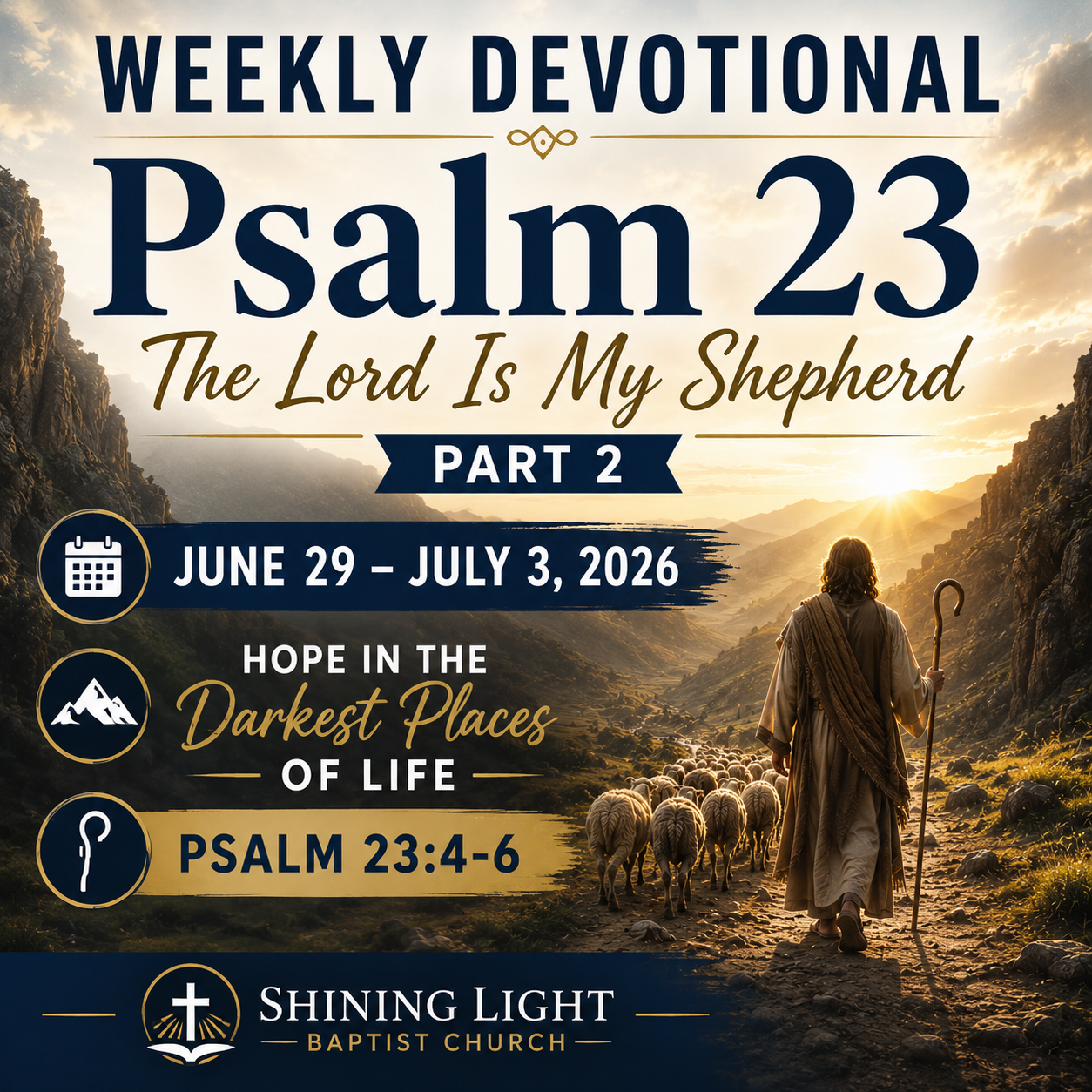
Weekly Devotionals -June 29 – July 3
Click the Blue Heading to Download Devotional
Monday: The Meaning of Hope
John and Jane Christian are still in Israel with their church group, spending each day at locations connected to the life of David as their guide Doug teaches them through Psalm 23. Monday morning the group gathered at a quiet overlook above the Judean hills. Doug opened by reminding them where they had been the previous week — the fields of Bethlehem where David grew up, the stream where the sheep were led to still waters, the shepherd’s path where they learned about the cast sheep and the paths of righteousness. “This week,” he told them, “we move into the final three verses. But before we do, we need to make sure we understand one word that holds the whole psalm together.” He told the group that the word was hope. He asked them to think about how they use that word in an average week. I hope the weather is nice. I hope things work out. I hope to be there. Jane nodded. She used that word almost every day. Doug told them that in modern language hope expresses a desire with some degree of uncertainty attached to it. You want something to happen but you are not sure it will. Ben said that was exactly how he used it. Doug smiled. “That is not what David meant.” He explained that the Jewish concept of hope is a confident expectation. It does not express uncertainty. It expresses certainty. It is the settled assurance of what God will do, not what you are wishing He might do. When David wrote this psalm, every expression of hope was a declaration of confidence in God. Because the LORD is my shepherd, David had confident expectation in every situation life brought him. Doug looked at the group. “That changes the way you read every verse in this psalm. David is not wishing. He is declaring.” John read through the first three verses quietly with that definition in his mind. It did change everything.
What Scripture Says
Psalm 23:1 — The LORD is my shepherd; I shall not want.
Romans 15:4 — For whatsoever things were written aforetime were written for our learning, that we through patience and comfort of the scriptures might have hope.
David opened the psalm with a declaration, not a wish. David was writing from a settled confidence in God built over a lifetime of watching Him provide. Paul reminded us in Romans 15:4 that everything written in Scripture was written to give us hope. It is the same confident expectation David expressed. What God did for David in the fields, on the run from Saul, in the battles, and on the other side of every dark valley, He is fully able to do for every person who makes Him their shepherd today.
Tuesday: The Valley of the Shadow of Death
Tuesday morning Doug drove the group into the Judean wilderness and stopped at the entrance to a narrow valley. The walls on both sides rose sharply, blocking most of the light. Even in the middle of the day the valley floor was dim. Ben looked up at the ridge lines above them and said it felt like the walls were closing in. Doug told him that was exactly the point. He opened his Bible to verse four and read it aloud. “Yea, though I walk through the valley of the shadow of death, I will fear no evil, for thou art with me, thy rod and thy staff they comfort me.” He told the group that shepherds in this region followed a seasonal pattern with their flocks. In the spring, as the snow melted on the higher elevations, fresh grass grew on the mountain pastures and the shepherds led their flocks up from the lower grazing areas to where food was more abundant. When the colder weather returned and the mountain pastures faded, they guided the flocks back down through the valleys to the warmer lowlands where the sheep could safely spend the winter. The valley was part of the journey both directions and there was no way around it.
Doug pointed to the valley walls above them. He told the group that the walls were so high sunlight only reached the valley floor when the sun was directly overhead. The rest of the time it was dark. And the darkness was not the only danger. Lions, bears, snakes, thieves, and robbers all threatened the flock in these valleys. The sheep had no way to protect themselves. The shepherd’s presence was not optional. It was the only reason they survived the journey. Jane looked down the length of the valley and thought about the people in her life who were walking through something dark right now. John stood quietly beside her thinking the same thing.
What Scripture Says
Psalm 23:4 — Yea, though I walk through the valley of the shadow of death, I will fear no evil: for thou art with me; thy rod and thy staff they comfort me.
The valley of the shadow of death is not a description of dying. Throughout the Old Testament the phrase is associated with darkness, gloom, danger, and affliction. David was describing the darkest and most dangerous seasons of life. The shepherd led the flock through the valley because he knew what was on the other side. The sheep followed because they trusted the shepherd. That is the picture David used to describe his own confidence in God through the hardest places of his life.
Wednesday: I Will Fear No Evil
John and Jane Christian are still in Israel with their church group, spending each day at locations connected to the life of David as their guide Doug teaches them through Psalm 23. Wednesday morning the group returned to the same valley and Doug led them further in along the floor. The walls pressed closer on both sides. Ben stayed near his dad. Doug stopped the group and asked them to look back at the entrance they had walked through and then forward at where the path continued. He told them that this was the view the sheep had every time the shepherd led them through. Doug asked the group to think about the places David described the shepherd taking him in the first three verses. Green pastures. Still waters. Paths of righteousness. He told them that all of those places were positive and pleasant and it was easy to appreciate the shepherd when those were the destinations. Then he read verse four again and pointed out something he wanted them to notice. In verses one through three David talks about the shepherd. He leads. He restores. He provides. But in verse four something changes. David stops saying he and starts saying thou. Right at the darkest moment in the psalm David stops describing God and starts talking directly to God. For thou art with me. John read it again and saw it immediately. The shift happens in the valley. Doug told them that David knew dark valleys personally. As a shepherd he had literally walked through them. As a young man he had stood in the shadow of Goliath and fought to the death. As a servant of God he had lived on the run from Saul for years. As a king he had fought battles and faced an uprising from his own son. David was not writing about the valley from a distance. He was writing from inside it. And what he declared from inside it was I will fear no evil. Not I hope things get better. Not I am trying to stay positive. A confident declaration rooted in one thing — for thou art with me.
What Scripture Says
Psalm 23:4 — Yea, though I walk through the valley of the shadow of death, I will fear no evil: for thou art with me; thy rod and thy staff they comfort me.
David expressed hope in the darkest places of life. His confidence was not rooted in his circumstances improving. It was rooted in the presence of the shepherd. The same God who led him to green pastures and still waters was with him in the valley. David had just as much confidence in God in the dark places as he did in the pleasant ones. That is the hope verse four offers. Not that the valley will be easy but that the shepherd is in it with you and He knows exactly where it leads.
Thursday: The Rod & Staff
Thursday morning Doug met the group at a spot along the shepherd’s path where a local shepherd had agreed to speak with them. He was an older man who had spent his entire life on these hills with his flock. He carried a rod in one hand and a staff in the other. Ben stared at both of them trying to figure out which was which. Doug introduced him to the group and then opened his Bible to verse four. He asked the shepherd to show the group the rod first. The man held it up — a short, thick club worn smooth from years of use. Doug explained that the rod was a weapon. The shepherd used it to defend the flock from predators. Lions, bears, anything that threatened the sheep had to get through the shepherd and the rod first. Then Doug asked him to show the staff. It was a long crook, the shape most people recognized. Doug told the group that the staff served a different purpose. It was used to guide the sheep in the right direction, to retrieve them when they wandered out of reach, and to keep the flock together on the path. Jane thought about how different the two tools were and yet how they worked together. One kept danger out. The other kept the sheep close. Doug told the group that the sheep eventually learned that when the shepherd’s rod or staff made contact with them it was a good thing. It was not punishment. It was the shepherd leading them or pulling them back from something that would hurt them. John thought about the times in his own life when God’s Word had done exactly that — conviction that felt uncomfortable in the moment but was pulling him back from a path he should not have been on. Doug closed by connecting both tools to the way God uses His Word. It convicts, which leads away from sin. And it retrieves, pulling people back when they wander. The rod and the staff in the hands of the shepherd were not instruments of harm. They were instruments of care. Beth looked at the older shepherd standing quietly on the hillside and thought he looked like exactly the kind of man you would want between you and a lion.
What Scripture Says
Psalm 23:4 — thy rod and thy staff they comfort me.
The rod defended the sheep from outside threats. The staff guided and retrieved them when they strayed. Both represented the same thing — the shepherd personally involved in every step of the journey. David found comfort in both, because he understood what they meant. The shepherd was close enough to use them. God guides His people with His Word, convicting them of sin and retrieving them when they wander. The comfort David described was the comfort of knowing the shepherd was close and fully engaged.
Friday:
Friday morning Doug gathered the group at an ancient site on the outskirts of Jerusalem and told them that everything they had studied this week had been preparing them for the final two verses. He opened his Bible and read verses five and six aloud, then pointed out that the imagery shifts completely in verse five. The entire psalm David had been describing God as a shepherd. In verse five God is no longer the shepherd. He is the host. And David is no longer a sheep. He is an honored guest at a banquet table. Doug explained that in the Ancient Near East the way a host welcomed a guest communicated everything. Preparing a table meant the guest was expected and valued. Anointing the head with oil was a gesture of honor and refreshment. A cup that overflowed communicated that the host was glad the guest had come and wanted them to have more than enough. He read Luke 7:44-46 where Jesus called out a Pharisee for failing to provide the basic hospitality customs of the day — no water for His feet, no oil for His head, no kiss of greeting. A woman considered a sinner had done all of it. David was confident God would receive him with every expression of honor that culture understood. Not tolerated. Fully welcomed. Ben asked why the table was set in the presence of enemies. Doug told him that David was not hiding from his enemies. He was seated at God’s table while they watched. That is confidence, not fear. Doug closed the week with verse six. Surely goodness and mercy shall follow me all the days of my life and I will dwell in the house of the LORD forever. He told the group that the word surely carries the force of absolute certainty in Hebrew. Goodness and mercy every day. The house of the LORD forever. Jane thought about the full journey of the psalm — the fields, the stream, the valley, the dark paths — and where it all ended. At a table. In a home. With a host who had been leading toward that destination the entire time.
What Scripture Says
Psalm 23:5-6 — Thou preparest a table before me in the presence of mine enemies: thou anointest my head with oil; my cup runneth over. Surely goodness and mercy shall follow me all the days of my life: and I will dwell in the house of the LORD for ever.
David shifted from the imagery of shepherd and sheep to host and honored guest. The table, the oil, and the overflowing cup were Ancient Near Eastern expressions of full acceptance and honor. David was confident he would be received by God as a welcomed guest with a cup that would never run dry. Verse six sealed it with certainty. David followed the shepherd through every season and the journey ended at the table of God.