Understanding Easter: Lesson 1 – Jewish Holy Days & Ceremonies – March 1, 2026
Understanding Easter – Lesson 1 – Jewish Holy Days & Ceremonies – March 1, 2026
Understanding Easter: Lesson 1
Jewish Holy Days & Ceremonies
March 1, 2026
Introduction
Each year at Easter, we take time to celebrate the death, burial, and resurrection of Jesus. It is a special day for Christians to remember and give thanks for salvation. A question worth asking is this: how would we understand Easter without the Old Testament? More specifically, how would we understand it apart from the holy days, ceremonies, and law God gave to Israel?
Paul explains this when he says, “Wherefore the law was our schoolmaster to bring us unto Christ” (Galatians 3:24). God used the law to teach His people and prepare them to understand salvation. He also explains that the holy days and ordinances were “a shadow of things to come;…” (Colossians 2:16–17).
God not only sent Jesus to save us, He provided the context needed to understand what salvation means. Over centuries, God taught His people about redemption before Christ came to accomplish it. This message looks at Leviticus 23 and highlights how God prepared His people to understand the saving work of Jesus Christ.
Context of Leviticus 23
Leviticus was given to Israel after God delivered them from Egypt while they lived in the wilderness. God was creating a nation who would live in a relationship with Him, that included learning how to worship Him, how to understand sin, and how forgiveness and fellowship worked in everyday life.
Leviticus 23:1–2 says, “Speak unto the children of Israel… Concerning the feasts of the LORD… these are my feasts.”
God established specific holy days that dictated Israel’s worship and manner of life. These appointed times shaped how God wanted His people to work, rest, sacrifice, and worship. Each holy day pointed forward to the redemption accomplished through Jesus Christ.
The Sabbath
Leviticus 23:3 begins with the Sabbath. God commanded six days of work and a seventh day of rest, a day set apart for worship. This law applied to all Jews, wherever they lived.
This means that one day every week, fields were left untouched, businesses closed, and normal labor stopped. God set apart that day so the Jews would step away from their work, rest from their labor, and turn their attention to Him in worship. This weekly rhythm gave regular time for work, rest, and worship.
God began teaching this to Israel while they were living in the wilderness. In Exodus 16, God provided manna for six days, and He instructed the people to gather only what they needed for that day. When the sixth day came, He told them to gather twice as much, because the seventh day was a holy sabbath set apart to the LORD. God said there would be no manna on the seventh day, and the people were not permitted to go out and gather or do their normal work. Israel learned that God could be trusted to provide what they needed and that setting apart a day to the LORD required real obedience.
Deuteronomy 5:15 says, “And remember that thou wast a servant in the land of Egypt, and that the LORD thy God brought thee out thence through a mighty hand and by a stretched out arm: therefore the LORD thy God commanded thee to keep the sabbath day.” God tied the Sabbath to Israel’s deliverance from slavery. In Egypt, they worked under a taskmaster without relief. Each Sabbath reminded them that they now belonged to the LORD who had redeemed them, and that redemption shaped how they lived and how they treated those under their care.
Jesus kept the Sabbath during His earthly life. Luke 4:16 says it was His custom to go into the synagogue on the Sabbath. Jesus also said that He is Lord of the Sabbath (Mark 2:28). Through His death and resurrection, Jesus completed the work the Sabbath pointed toward.
Hebrews 4 explains that believers enter God’s rest by trusting what Christ has done, no longer striving to earn acceptance. The Sabbath teaches that salvation comes from God’s finished work and leads to true rest.
________________________________________________________________________________________________________________________________________________________________________________________________________________________
Passover: Deliverance Through the Blood
Leviticus 23:4–5 introduces Passover. Passover was a yearly observance God gave Israel to remember the night the LORD delivered them from Egypt.
The meaning of Passover is found in Exodus 12. The LORD announced judgment on Egypt. He said death would come to every firstborn in the land as judgment against Egypt’s rebellion. The LORD also provided a clear means of protection for Israel.
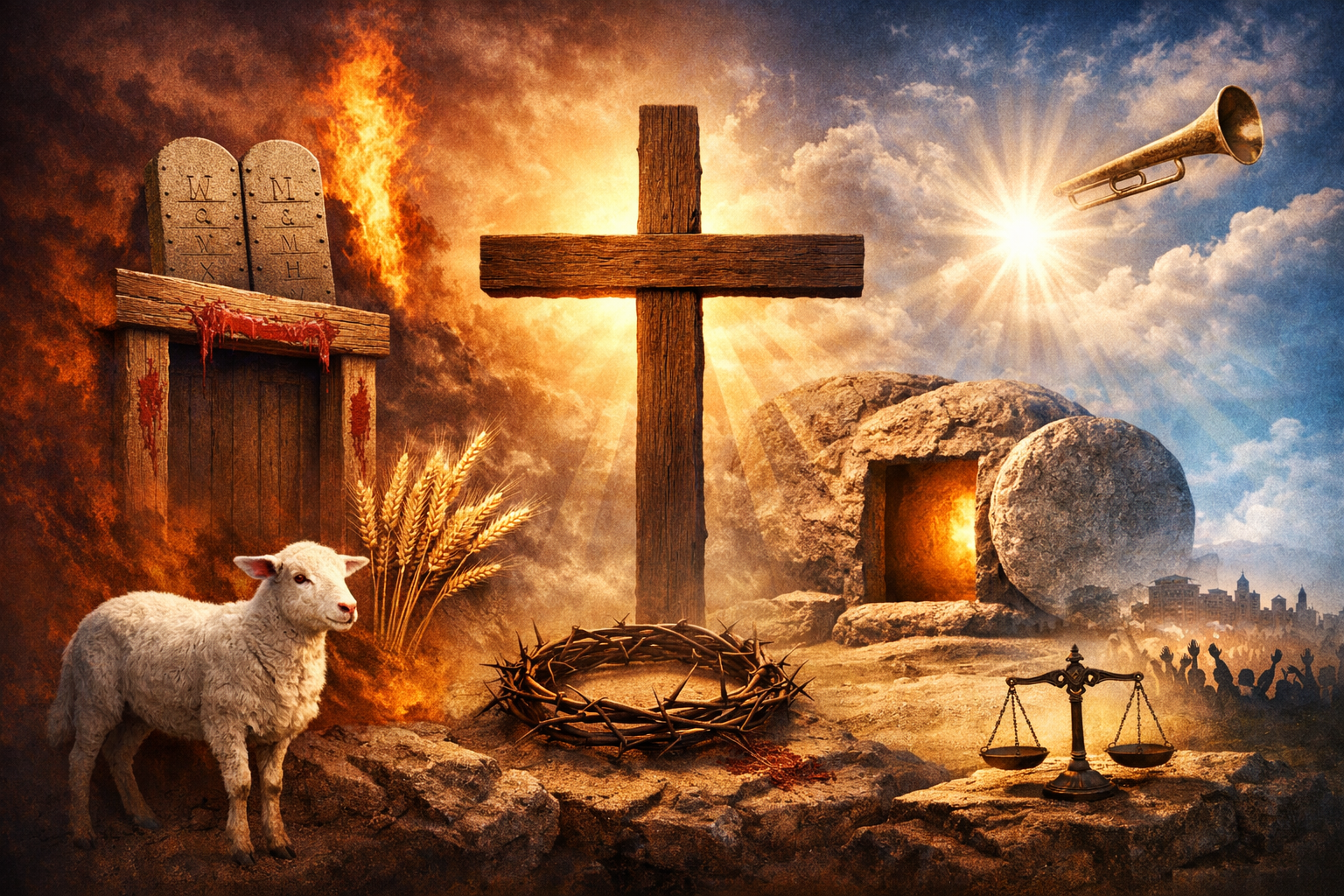
The LORD instructed Israel to take a lamb, kill it, and apply its blood to the doorposts and lintel of their homes. He said, “When I see the blood, I will pass over you” (Exodus 12:13). Houses where the blood was applied were passed over; but the death angel entered the houses that did not have the blood applied to the door and the firstborn was killed.
The LORD commanded Israel to remember this night every year. Passover was established as a memorial of what the LORD had done. Each time it was observed, they remembered what the Lord had done. This is sort of like our communion now.
For them it was the blood of the sacrificial lamb that kept them safe. This points us to Jesus because He became our Passover lamb at Calvary. 1 Cor 5:7 says “Christ our Passover is sacrificed for us.” It was on the annual celebration of Passover that Jeus was crucified for us. We will learn more about this in the next sermon.
________________________________________________________________________________________________________________________________________________________________________________________________________________________
Firstfruits: Life After Death
Leviticus 23:9–14 establishes the Feast of Firstfruits. When the harvest began, Israel brought the first sheaf to the priest to be accepted before the LORD.
They were not permitted to eat the harvest until the offering was made. This showed that life and provision came from God.
The first sheaf was not the full harvest. It was the beginning, a promise that more would follow.
This feast occurred “on the morrow after the sabbath,” the first day of the week. This is the day Jesus rose from the dead.
Paul explains, “Christ is risen from the dead, and become the firstfruits of them that slept” (1 Corinthians 15:20). His resurrection guarantees the resurrection of those who trust Him.
Jesus illustrated this in John 12:24, explaining that grain must die to produce life. His death and burial would lead to life for many.
Firstfruits teaches that salvation leads to life beyond forgiveness. The resurrection shows death does not have the final word. Because Christ lives, His people will live also.
________________________________________________________________________________________________________________________________________________________________________________________________________________________
The Feast of Weeks (Pentecost): Harvest and the Spirit
Leviticus 23:15–22 establishes the Feast of Weeks. This feast was observed fifty days after Firstfruits and marked the completion of the grain harvest. Israel gathered to thank the LORD for what He had provided and to worship Him for bringing the harvest to completion.
God instructed Israel to count the days from Firstfruits to this feast. Firstfruits was observed on the day after the Sabbath. That is the same day Jesus rose from the dead. Fifty days later, Israel observed the Feast of Weeks.
Acts 2 records that the Holy Spirit was given on that same day, the day of Pentecost. After Jesus rose from the dead and returned to heaven, the Holy Spirit came upon the disciples. They were given the ability to speak and proclaim the message of Jesus Christ. Peter preached the gospel, and Scripture says that about three thousand people received the word and were saved that day (Acts 2:41).
This fulfilled what God had spoken through the prophet Joel. God had said He would pour out His Spirit, and He did so on the very day He had already set apart (Joel 2:28–29).
The Feast of Weeks shows what followed the resurrection of Jesus. Christ rose from the dead at Firstfruits. Fifty days later, the Holy Spirit was given. On the day Israel celebrated harvest, God gathered people to Himself through the gospel.
________________________________________________________________________________________________________________________________________________________________________________________________________________________
The Feast of Trumpets: A Call to Prepare
Leviticus 23:23–25 establishes the Feast of Trumpets. This feast took place on the first day of the seventh month. God required Israel to stop their normal work and gather for a holy convocation. This day was set apart to the LORD.
The defining feature of this holy day was the blowing of trumpets. Leviticus calls it “a memorial of blowing of trumpets.” The trumpet marked the beginning of the seventh month and announced that Israel had entered the final season of holy days. From this point forward, the focus turned toward dealing with sin and standing before God.
Ten days after the Feast of Trumpets came the Day of Atonement. The trumpet sounded ahead of that day as a warning. It called the people to stop, reflect, and prepare themselves before the LORD.
The Old Testament connects trumpet blasts with the day of the LORD. Joel wrote, “Blow ye the trumpet in Zion… for the day of the LORD cometh” (Joel 2:1). The trumpet warned the people that a day was approaching when they would stand before God.
The New Testament uses the same imagery. Scripture teaches that Jesus Christ will return with the sound of a trumpet. Paul wrote that the Lord will descend with the trump of God (1 Thessalonians 4:16), and that at the last trumpet the dead will be raised (1 Corinthians 15:52). Scripture also teaches that following His return, all people will stand before Him in judgment.
The Feast of Trumpets directs attention to the return of Jesus Christ. The trumpet announces His coming, the resurrection of the dead, and the judgment that follows as all people stand before Him. The same Jesus who rose from the dead will return to complete God’s plan.
________________________________________________________________________________________________________________________________________________________________________________________________________________________
The Day of Atonement: Sin Dealt With by God
Leviticus 23:26–32 establishes the Day of Atonement. This was the most serious holy day given to Israel. God required the people to stop their work, humble themselves, and confess their sin before Him.
Leviticus 16 explains what took place on this day. The high priest entered the Holy of Holies, the place of God’s presence. Blood was brought before the LORD to make atonement for sin. One goat was sacrificed, and its blood was presented to God. Another goat had the sins of the nation placed upon it and was sent away into the wilderness. God showed His people that sin required death and that sin was carried away from them by His provision.
God commanded this day to be observed every year. On this day, atonement was made for the sins of the entire nation, allowing Israel to continue in fellowship with the LORD for the year that followed.
The book of Hebrews explains how Jesus fulfilled the Day of Atonement. Jesus entered God’s presence with His own blood and obtained eternal redemption (Hebrews 9:12). He served as the High Priest who brought the offering, and He was the sacrifice whose blood was given.
Jesus also fulfilled what the scapegoat represented. Scripture teaches that He bore our sin and suffered outside the city (Hebrews 13:11–12). Through His death, our sin was carried away, and guilt was removed.
Jesus completed what the Day of Atonement required. Through Jesus Christ, our sin is forgiven, our guilt is removed, and fellowship with God is restored.
________________________________________________________________________________________________________________________________________________________________________________________________________________________
The Feast of Tabernacles: Life With God
Leviticus 23:33–43 establishes the Feast of Tabernacles. This feast lasted seven days and followed the Day of Atonement. After sin had been dealt with, God called His people to a time of rest and rejoicing before Him.
During this feast, Israel lived in temporary shelters made of branches. God commanded this so they would remember how He brought them out of Egypt and cared for them while they lived in tents in the wilderness. The shelters reminded them that God provided, protected, and remained with them throughout their journey.
The Feast of Tabernacles focused on God’s presence with His people. After deliverance from Egypt, after years of wandering, and after the yearly removal of sin on the Day of Atonement, God brought His people to a time of joy and fellowship in His presence.
The New Testament explains this truth through Jesus Christ. John 1:14 says that the Word became flesh and dwelt among us. Jesus came to live among His people. God’s presence was no longer represented by a tent. God came near through His Son.
Scripture also points forward to a future fulfillment. Revelation 21:3 describes a day when God will dwell permanently with His people. God’s presence will no longer be temporary or symbolic. He will live with His redeemed people forever.
The Feast of Tabernacles shows the goal of redemption. God delivers from judgment, removes sin, and restores fellowship. Salvation leads to life with God, lived in His presence with joy and rest.
________________________________________________________________________________________________________________________________________________________________________________________________________________________
Conclusion
God taught salvation by building it into Israel’s normal life. Through holy days and ceremonies, He taught His people what sin is, how atonement works, how He delivers from judgment and bondage, and what hope looks like. These holy days interrupted ordinary routines and required families to explain God’s commands and actions. Parents taught their children why blood was shed, why sin had to be confessed, how God had delivered His people in the past, and why they lived in hope of what God had promised to do.
Over time, these repeated observances taught clear truths. Sin separates people from God. Atonement requires blood. Deliverance comes from the LORD. Life with God is the goal. Each generation learned these truths by seeing them practiced again and again.
We have seen how each of these holy days taught part of God’s plan of redemption. God taught rest, deliverance through blood, life after death, the gathering of His people, preparation for judgment, the removal of sin, and life with Him. Together, these holy days prepared God’s people to understand what would happen when Jesus came to suffer, die, and rise again.
The death, burial, and resurrection of Jesus bring those lessons together. Jesus died as the sacrifice God accepts, shedding His blood for sin. He was buried, and He rose from the dead and gives life. Through Him, sin is forgiven, guilt is removed, and fellowship with God is restored. What God taught through centuries of holy days and ceremonies was fulfilled through the work of Jesus Christ.
This sermon teaches us that God intentionally builds reminders and teaching opportunities about salvation into the rhythm of life. He did that for Israel through holy days and ceremonies that taught sin, atonement, deliverance, resurrection, and life with God. God still desires His people to live with those truths in view.
The Easter season gives us a clear opportunity to do this. This is a time to build intentional moments into our lives and homes to remember the death, burial, and resurrection of Jesus Christ. It is a time to talk openly about why Jesus died, why His blood was necessary, what His resurrection accomplished, and what hope we now live with because He lives.
For families, this means explaining these truths to the next generation. Parents can use this season to teach their children about sin, forgiveness, sacrifice, new life, and future hope in a way that is clear and rooted in Scripture.
For every believer, the application is to be intentional. Build reminders into your life that keep the work of Christ central. Set aside time for reflection, worship, Scripture, and conversation. Let the rhythm of this season reinforce the gospel truths God has taught.
God taught salvation patiently and repeatedly. As we remember the death, burial, and resurrection of Jesus Christ, we are called to live with the same kind of intentional rhythm, keeping the work of Christ at the center of our lives and homes.